Consulting & contract services

Custom CRM and AI services

Built around what you need. Not limited to the nonprofit space.

We built Sapling because we saw important work being held back by tools that did not fit the people using them. That problem is not unique to nonprofits, and neither is what we can build. A business might need a CRM that reflects how its customers actually buy. A small team might need an AI assistant to make years of knowledge easier to use, or a custom tool that replaces hours of moving information by hand. Whatever your industry, we want to understand what you are trying to accomplish and help build the software to get you there. You do not need to arrive with a technical specification or a product picked out. Bring us the problem, the idea, or the thing you wish existed, and we can work with you to shape it into something your team can use.

Keep the tools that serve you. Improve the parts that do not. You do not need to use Sapling CRM to work with us.

Built around the work

From a better workflow to a purpose-built system.

A CRM shaped around your work.

Sometimes a better configuration is enough. Sometimes the missing piece is a new workflow, a specialist module, or a purpose-built system. We help define the difference before you invest, then scope the design and development around how your organization actually operates.

  • Custom records, fields, relationships, and staff workspaces
  • Donor portfolios, moves management, intake, and approval workflows
  • Migration planning, import preparation, and record reconciliation
  • Role-based access, reporting requirements, and documented operating rules

What you leave with: A requirements and data model, an agreed implementation scope, and a tested workflow with a staff handoff.

Connections that carry the context.

Your team should not have to re-enter the same information in three places. We assess the available APIs, exports, and access permissions, then design connections with clear ownership of each field and a plan for what happens when a handoff fails.

  • Connections between CRM, giving, email, events, and finance tools
  • API integrations, webhooks, scheduled syncs, and controlled file transfers
  • Field mapping, duplicate handling, and source-of-truth decisions
  • Failure alerts, retry rules, reconciliation, and integration documentation

What you leave with: A system map, field-level mapping, tested data handoffs, and a support plan appropriate to the connection.

AI with a useful job to do.

Start with the work, not a chatbot in search of a purpose. We help identify where AI can reduce preparation time, make information easier to find, or turn an unstructured input into something your team can review and use.

  • Assistants grounded in approved organizational content
  • Research summaries, briefing drafts, and document workflows
  • Data classification, cleanup suggestions, and review queues
  • Scoped agent workflows with permissions, approval steps, and human handoffs

What you leave with: A defined use case, source and permission boundaries, evaluation examples, and a pilot your team can assess before a wider rollout.

The tool between the tools.

Not every problem needs a new CRM. A focused portal, a well-designed form, or an internal dashboard can remove a recurring bottleneck without replacing the systems your team already knows.

  • Staff dashboards, operational queues, and custom reporting
  • Constituent portals, intake forms, and self-service experiences
  • Campaign tools and connected website or giving experiences
  • Internal utilities for reviewing, preparing, and moving data

What you leave with: A focused interface, agreed acceptance criteria, testing, and documentation for the people who will use and maintain it.

We build software, too

Fundraising knowledge. Hands-on technical experience.

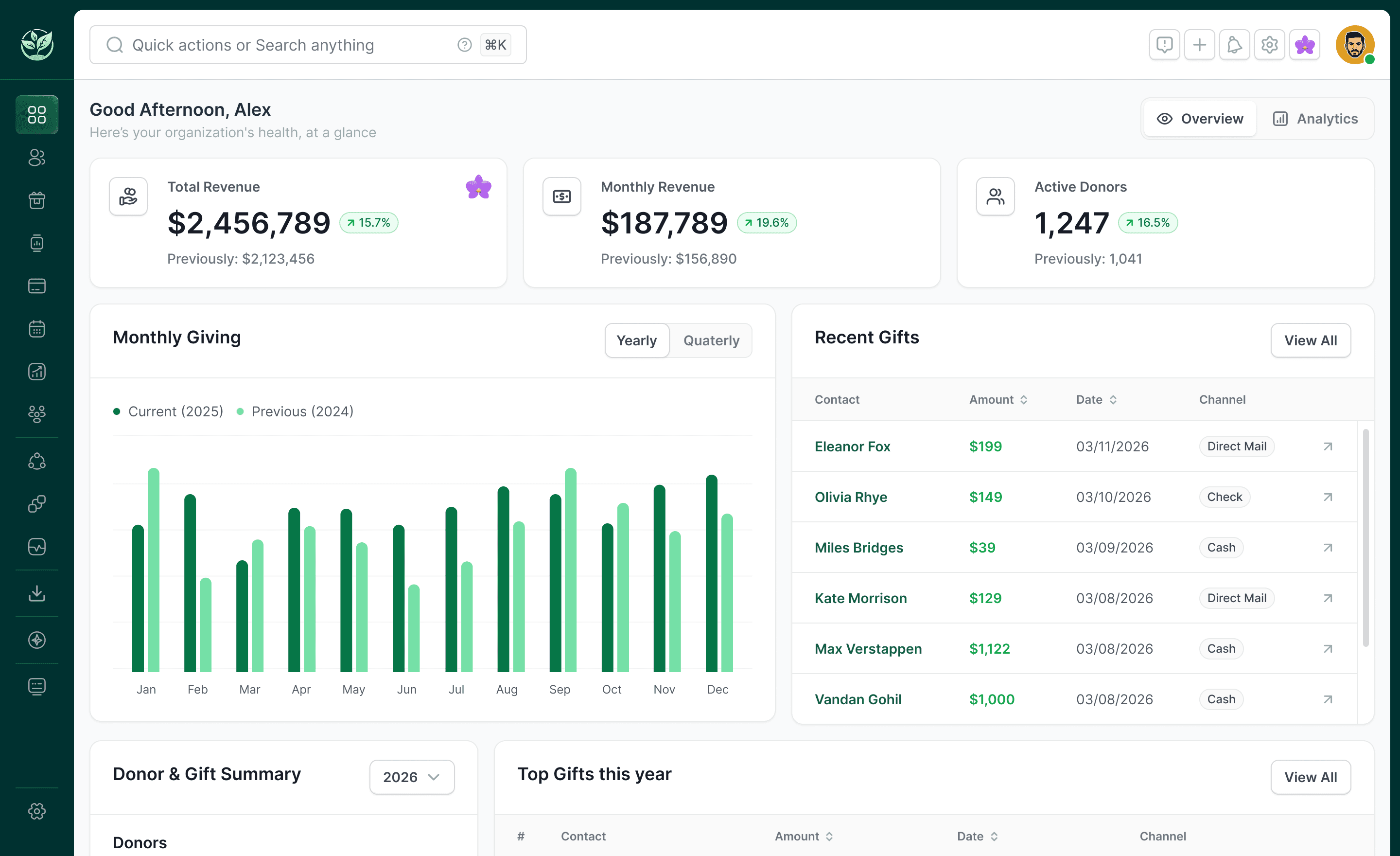
Sapling CRM is one expression of how we approach connected fundraising work. That experience informs our consulting, but it does not dictate your technology choice. The goal is a system your team can trust and use, whether it is ours, yours, or something we build together.

Sapling CRM dashboard showing giving totals, donor activity, and recent gifts
Sapling CRM, our own product. Custom engagements are scoped around your organization and may use other platforms.
Custom Orchid integrations

Orchid as your AI concierge.

Bring a fundraising-aware assistant to the places your community and team already work. We can scope an Orchid plug-in concierge around your website, approved content, and existing tools, without requiring a move to Sapling CRM.

A welcome for your visitors.

Explore a website concierge that helps people find giving options, understand your programs, navigate event information, and reach the right person. Shape its answers around your voice and the information your organization approves.

A helping hand for your team.

Plan an internal assistant for finding guidance, preparing drafts, and navigating everyday workflows. We assess which systems can connect, what information it may use, and where a person needs to review or take over.

Possible starting points

Start with the part that keeps slowing you down.

These are examples of projects we can discuss, not packaged integrations or promises of a particular result.

From event registration to donor follow-up

Map how registrations, gifts, and attendee relationships should reach the CRM. Define matching rules, an exception queue, and the follow-up tasks staff need after the event.

From scattered files to a usable portfolio

Prepare imports, reconcile records, and shape a caseload view with the fields, history, and next actions your fundraisers actually use.

From repeated questions to reviewed answers

Scope an assistant around approved content, test it against real questions, and define how uncertain answers or sensitive requests reach a person.

A clear engagement

Know what we are building, and why.

  1. Understand the problem

    We review the current workflow, talk through who uses it, and identify the friction, constraints, and systems involved. The first decision is whether to configure, connect, build, or leave something alone.

  2. Define the engagement

    Together, we agree on deliverables, responsibilities, access, acceptance criteria, and a budget and timeline. Third-party costs, dependencies, and anything outside the scope are made explicit.

  3. Build and review

    Work is organized around reviewable milestones. We test with agreed examples, check permissions and failure cases, and give your team a chance to validate the workflow before release.

  4. Launch with a handoff

    The engagement includes the agreed documentation and staff handoff. Hosting, maintenance, support, and future improvements are addressed in the scope rather than left as assumptions.

Before we build.

Do we have to use Sapling CRM?

No. We can work with your current systems, help evaluate alternatives, or scope a custom solution. Sapling is an option, not a condition of working with us.

Can you work with a CRM or tool we already have?

We start by reviewing its configuration options, API access, licensing, and export capabilities. We will be clear about what can connect, what needs vendor cooperation, and where a limitation changes the project.

Can an AI assistant take actions for us?

Where the agreed integrations support it, we can scope actions as well as answers. Permissions, review requirements, logging, and stop conditions are defined for the specific workflow. Sensitive actions are not assumed to be safe to automate.

How do you approach donor data?

We agree on what data is needed, who can access it, and which systems or AI providers may process it before implementation. Public-facing assistants should use approved public content, not expose private donor records.

What does a project cost?

Custom work is quoted around the scope, complexity, integrations, and ongoing responsibilities. We can start with a focused assessment or pilot before committing to a larger build. Software subscriptions, AI usage, and hosting costs are discussed separately where applicable.

Tell us what your tools cannot do yet.

Bring the process, the bottleneck, or the idea. Tell us which systems you use, who needs the solution, and what a useful outcome would look like. We will help define a practical next step.